China's Bubble Tea Industry Slowdown Sparks a Hunt for New Categories
Key facts
- Sociologist Ray Oldenburg described three anchors in daily life: home, the "first place", work, the "second place", and a neutral social space in between, the "third place", where people gather without a fixed agenda.
- Hybrid and flexible schedules across the Gulf have shortened the time many young professionals spend anchored to a single office, and cafes are increasingly filling that gap as informal meeting points.
- In Riyadh, prime office rents rose 3 percent to SR3,320 (about 887 dollars) per square meter in the second quarter of 2026, and developers are now setting aside roughly 15 to 20 percent of gross leasable area in new commercial projects for flexible workspace operators, according to CBRE data reported by trade outlet Allwork.Space.
- In Dubai, professionals describe building genuine friendships and business collaborations that start at a cafe table or a shared coworking desk, according to a September 2026 Emirates 24|7 feature on the city's networking culture.
What it means across the Gulf
Across Riyadh, Dubai, Doha and other Gulf cities, a similar pattern is showing up among professionals in their twenties and thirties: work no longer happens only inside one building on a fixed nine-to-five. Gulf employers increasingly offer staggered hours, compressed weeks or hybrid arrangements that reduce the number of hours a young professional spends tied to a single desk. That flexibility also removes some of the automatic daily contact a traditional office used to guarantee, the hallway conversation, the shared lunch break, the colleague two desks over.
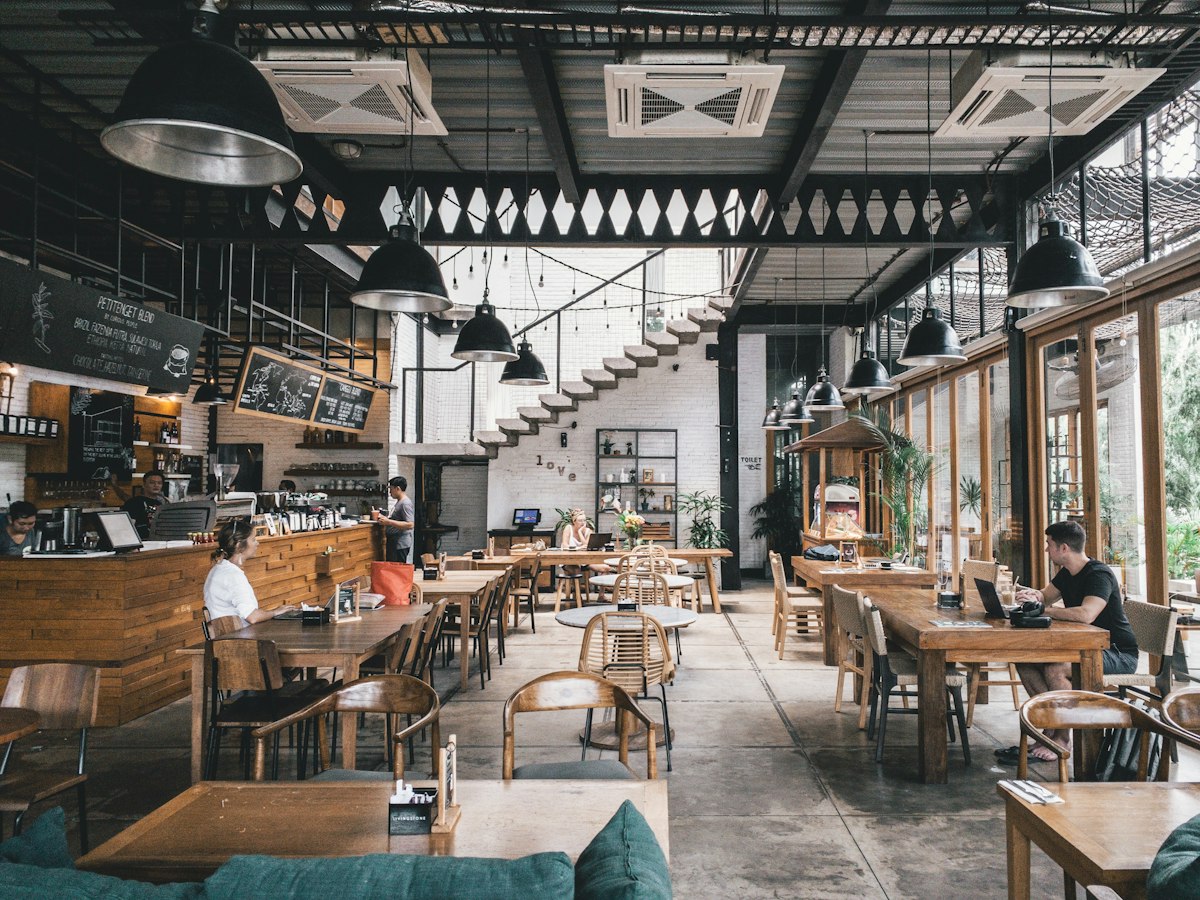
Cafes are stepping into that space. In Dubai, personal branding strategist Marion Mendes, who relocated to the city in December 2025, told Emirates 24|7 that some of her closest professional relationships began with casual encounters at cafe tables and shared coworking desks, ties that grew into an informal working group: people who sit near one another while pursuing separate ventures, share lunch, and mark each other's milestones. The same logic applies wherever Gulf professionals have both the flexibility and the cafe infrastructure to use it, and Riyadh's King Abdullah Financial District, where flexible workspace is expanding fastest, is one clear example of that infrastructure catching up with the demand.
For a generation used to moving between home offices, client meetings and short commutes, the cafe functions as both a control room and a living room, a fixed point in an otherwise flexible week.
Background
Oldenburg introduced the third place idea in his 1989 book "The Great Good Place", arguing that informal public gathering spots, cafes, pubs, barbershops, community halls, matter for civic life precisely because they ask nothing of visitors beyond showing up. He contrasted them with the more structured demands of home and workplace.
The Gulf carries its own version of that history. Long before "third place" became a term used by real estate consultants, the majlis and the qahwa gathering already served a comparable social function, a space set aside for hosting, conversation and unhurried time together. What has changed is the overlay of hybrid work on that older hospitality tradition: the same table that once hosted a purely social gathering now just as often hosts a laptop, a muted video call, and a coffee that gets refilled between tasks.
Commercial real estate is adjusting to the same shift. Office landlords in Riyadh are now expected to bundle retail, dining and green space into new developments rather than deliver bare floor plates, a sign that the line between workplace and social space is being redrawn at the planning stage, not only in individual habits.
Takeaway
The third place concept was coined to describe a shortage, too little unstructured social space between home and work in car-dependent Western suburbs. In the Gulf's hybrid-work economy, cafes are absorbing that role for a young, mobile professional class, not as a replacement for the office, but as the connective tissue between a flexible schedule and a coffee culture that already knew how to host people well before coworking became a business model.